What are Rollups in Crypto: A Detailed Guide



Over the last couple of years, scalability has remained the most persistent bottleneck and the most sought-after breakthrough in blockchain infrastructure. As blockchain networks grow in popularity and the number of users increases, there is a clear limitation in transaction throughput and an increase in latency, leading to high fees and transaction times.
The current capabilities of blockchain networks cannot meet the ever-increasing demand. On Ethereum, for example, this disparity between blockchain capability and demand is due to reasons such as limited block size that constrains the number of transactions each block can accommodate.
This leads to longer transaction times, with an average transaction taking between 15 seconds to 5 minutes, and higher costs per transaction. Now we are facing a challenge on how to keep transactions fast, cheap, and secure in a decentralised system.
In this article, we will have an in-depth look at one of the most widely agreed-upon methods to solve the scalability problem in the blockchain, which is blockchain rollups.
#Blockchain rollups TL;DR
- Scalability is the blockchain’s biggest bottleneck, and Rollups are L2 scaling solutions designed to solve this.
- Rollups work by executing transactions off-chain and posting compressed data or proof back to the L1
- There are two main types of Rollups: Optimistic and Zk Rollups
- Unlike sidechains, Rollups derive their security and finality directly from Ethereum
- The future of Rollups is modular, with EIP-4844 being a step in the right direction towards a modular future.
#What are Blockchain Rollups?
Blockchain rollups are an L2 scaling solution that increases the transaction per second on Ethereum without increasing gas costs by rolling multiple transactions into one by bundling and compressing them into an L1. Instead of the L1 holding and processing multiple transactions, it only receives data about them, helping to alleviate the computational burden from the primary network.
After the off-chain processing, rollups post the transaction back on the Ethereum network and still derive their security from the Ethereum protocol. Rollups reduce trust assumptions by leveraging Ethereum for settlement and data availability, instead of relying solely on off-chain consensus.
When a user initiates a transaction, the roll-up takes the transactions and executes them off-chain using the roll-up's execution environment. Once multiple transactions are executed, a new state root is produced, and at regular intervals, the Rollup posts a Rollup commitment back to Ethereum.
In simple terms, a Rollup consists of a set of smart contracts on L1 and network nodes on L2, with the L2 handling the transaction execution while the L1 is responsible for settlement, consensus, and data verification, ensuring the security of transactions. The process is similar for all types of rollups, and the way these rollups check the validity of transactions is a major distinguishing factor.
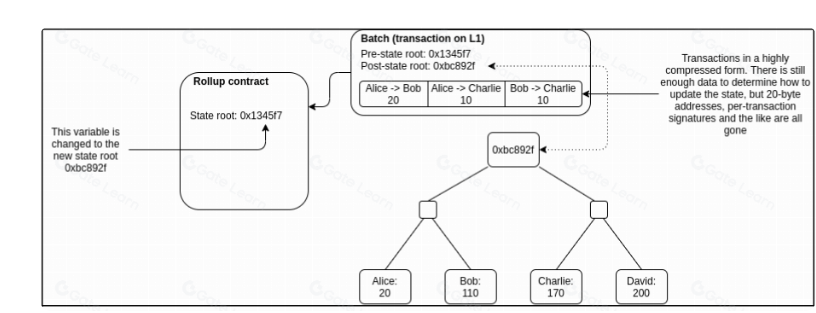
Image: Working principle of rollups from Vitalik
#Types of Rollups
There are two types of blockchain rollups, and these are:
- optimistic rollups and
- zero-knowledge rollups.
In this chapter, we will go into details and explore what these Rollup types are and how they differ from each other.
#What are Optimistic rollups?
Optimistic rollups are optimistic by default. This means that it assumes the transactions executed on the L2 are valid until proven otherwise. Optimistic Rollups allow people to challenge these transactions by submitting a fraud proof within a time window known as the challenge period. This challenge period lasts between 1-7 days, depending on the specific implementation. Projects adjust the duration based on specific requirements or user preference for fast finality.
The fraud proof involves the disputing operator playing a call response game with another operator until they narrow the dispute to a single computational step executed on the L1. If the fraud proof is found to be true, i.e a batch of transactions is found to be invalid, the transaction is reverted. Disputes are resolved via an interactive fraud-proof protocol, which narrows the disagreement to a single step of execution, re-executed on L1. If fraud is detected, the malicious sequencer’s bond is slashed.
This optimistic approach of requiring a fraud proof only when disputes arise makes the Optimistic Rollup more cost-effective and efficient. The challenge period, however, tends to increase transaction confirmation times, and this is a major downside of the Optimistic Rollups.
Examples of L2S that leverage optimistic rollups include: Arbitrum, Metis and Optimism.
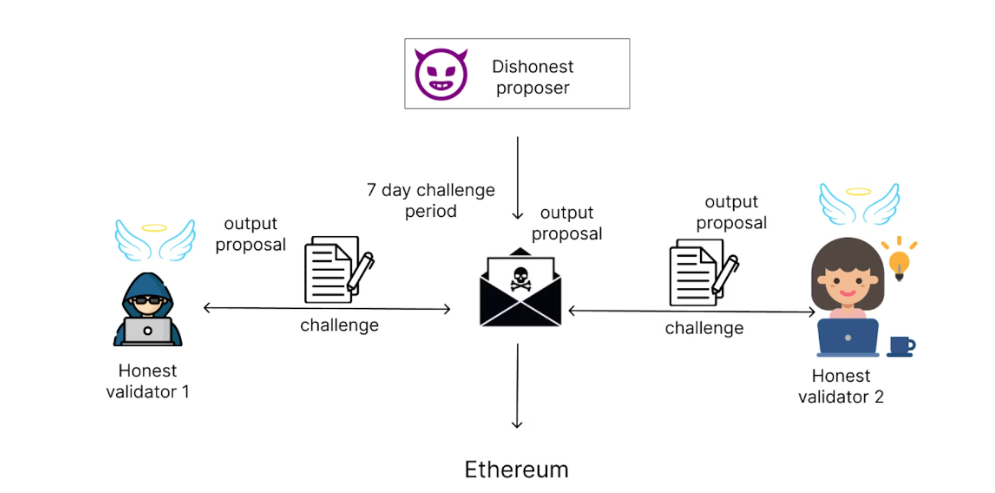
Image: Optimistic Rollups
#What are Zero Knowledge Rollups?
Zero-knowledge Rollups verify off-chain transactions using zero-knowledge proofs, offering high security and privacy to ascertain if any batch of transactions is correct using a validity proof (a complex mathematical zero-knowledge proof) submitted on-chain for every batch of transactions.
The use of cryptographic proofs makes zk rollups a robust and secure choice, especially for use cases where immediacy and high trust finality matter.
The execution process for zK rollups is similar to optimistic rollups, as transactions are executed off-chain, and the distinction lies in the way they authenticate these transactions. zK rollups generate validity proof of transactions in batches, enabling verified integrity before submitting to the main chain. The proof verifies the correctness of all transactions within a batch without exposing any underlying information and without requiring the L1 to validate each transaction individually. Examples of L2S that leverage the zk rollups include Starknet and zKsync.
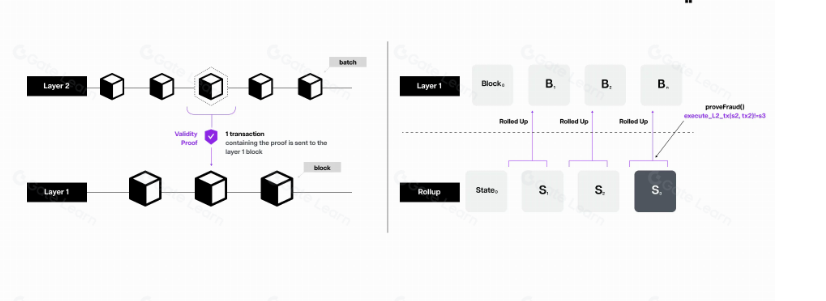
Image: zK rollups (left) vs Optimistic Rollups (right)
#Rollups Vs Sidechains: What is the difference?
We must understand the differences between rollups and side chains. Both rollups and side chains aim to scale Ethereum, but there are differences in how they achieve it. While side chains operate independently from Ethereum’s layer one and have their own consensus mechanism, rollups inherit Ethereum's inherent security, making rollups more secure and trustworthy when compared to side chains.
#Core Component of Rollup Architecture
Now that we have discussed the basics of rollups, let us delve into the key components that make up a Rollup architecture. Sequencer: The sequencer is a crucial component of L2 network nodes and is the operational heart of most rollups. It is responsible for batching transactions, receiving transaction requests, determining the order of execution, and passing them to L1 smart contracts. The sequencer is an important part of improving transaction processing efficiency and user experience.
The Execution layer is an abstract component that in itself may be composed of several components. This is where the transaction is processed and state changes occur. It is responsible for executing transactions off-chain by fetching the transaction data and constructing the state of the Rollup. The primary function of the execution layer is to execute the Rollup’s state transition function. By executing this function, it stores a VM state, which is a deterministic result of the ordering of blocks produced by the sequencer. More specifically, the sequencer is a software-based mechanism used in L2 protocols to append inputs to a Rollup.
The Consensus layer is a network of sequencers that agree on the order of transactions in a block before posting the data required to reconstruct the chain state to the data availability layer. The consensus layer determines how nodes agree on the state of the Rollup and often involves sequencer selection mechanics, leader election algorithms or threshold signature schemes.
The Data Availability layer: Is the layer responsible for storing transaction data and making it available for verification. The data availability layer guarantees that everyone can access the data required to reconstruct the Rollup state. With the data availability layer, users can verify the Rollup state, prove fraud or trust proof correctness. It often involves data compression techniques, called data optimisation, and potentially separate DA networks.
The Settlement layer: The settlement layer provides the objective on-chain finality, and state changes occur. The settlement layer ensures the finality and security of the settlement processed on the Rollup by verifying and arbitrating proofs. When there is a dispute, the proof can be checked on the settlement layer. For classical, optimistic, and zK rollups, Ethereum is the settlement layer. Not all rollups have settlement layers, and a Rollup without a settlement layer is called a sovereign Rollup.
#Future of rollups and Modular blockchain ecosystems
Proto-danksharding (EIP-4844) introduced via (EIP 4844)[https://eips.ethereum.org/EIPS/eip-4844] is a pivotal upgrade in Ethereum’s rollup-centric roadmap to enable cost-effective high-throughput scalability by introducing a new transaction type called Binary Large Objects (Blob) carrying transactions. Blobs are large units of data designed to be a part of Ethereum's transactional structure.
This solves an important bottleneck in rollup, which is the calldata cost. Rollups use calldata to post transaction batches and state roots to Ethereum L1. This call data is expensive because they are stored indefinitely. This permanence is not necessary for rollups since they require data for only a limited amount of time to validate and execute transactions.
But with Proto danksharding, data blobs will be stored on the consensus layer of Ethereum and will automatically delete in one to three months, and we can now get massive data throughput at a cheaper price with blobs that reduce storage overheads. The proto danksharding lays the groundwork for introducing more advanced techniques for reducing blob costs without increasing computational load on nodes.
#Final Thoughts: Why You Should Care
Rollups are not just a scalability patch, but they are a long-term plan to unlock advancements in blockchain technology and to increase throughput to boost productivity. Lower gas fees mean developers can build high-frequency applications with cases to solve real-world problems without pricing users out with exorbitant gas fees. This automatically translates to user growth and more ecosystem-wide innovation.