What is MEV in Blockchain: Infrastructure & Cross-Chain Strategies



MEV blockchain operations have evolved far beyond single-chain mempool monitoring. What started as Ethereum validators reordering transactions for profit now spans multiple networks, bridge protocols, and cross-chain arbitrage strategies. The modern MEV blockchain ecosystem requires infrastructure that can detect opportunities across Ethereum, Solana, Avalanche, and other networks simultaneously.
In this guide, we explore what MEV in blockchain is, how value extraction works on individual chains, what infrastructure MEV operations require, and how these systems scale across multiple networks simultaneously.
#What is MEV?
MEV (Maximal Extractable Value) refers to profit generated by controlling the ordering, inclusion, or exclusion of transactions within a blockchain block. It is commonly captured through strategies like arbitrage, liquidations, and front running, where execution speed and transaction priority determine profitability.
#Why Cross-Chain MEV Changes the Game
Cross-chain MEV blockchain operations are where the most complex operators compete. Price discrepancies between chains create arbitrage opportunities invisible to single-chain bots, while bridge transactions introduce MEV extraction points that don't exist within individual networks.
In combination, this means that running this infrastructure requires coordinating different consensus mechanisms, managing varying hardware demands, and building monitoring systems that track states across incompatible ecosystems.
#Why Infrastructure Matters More Than Strategy
Infrastructure matters more than strategy in the MEV blockchain space. A perfect arbitrage algorithm can be rendered worthless if the nodes can't access mempool data fast enough. When opportunities exist for mere milliseconds, low-latency execution trumps clever trading logic every time . This is why serious MEV operations run their own dedicated infrastructure rather than relying on shared RPC providers.
Running high-performance MEV blockchain nodes requires predictable hardware performance, which dedicated infrastructure delivers better than virtualized cloud environments. Bare metal infrastructure providers support these workloads through bare metal configurations, while some providers like Cherry Servers offer further specialized equipment optimized for blockchain node operations.
Single-chain MEV is already competitive - searchers run dedicated infrastructure to monitor Ethereum's mempool or bid in Solana's priority auctions. Cross-chain MEV multiplies the opportunity surface, but also multiplies complexity in coordinating incompatible systems, monitoring multiple mempools, and executing where one chain's 400ms blocks conflict with another's 12-second finality.
#What is MEV in Blockchain: Understanding the Fundamentals
Maximal Extractable Value (MEV) refers to profit extracted from transaction ordering, inclusion, or exclusion within blocks. Validators and block producers control what transactions get included and in what order. This control creates opportunities to extract value beyond standard block rewards and transaction fees.
To understand how MEV works in practice, it helps to first look at the structure behind it. Who decides transaction order, how participants compete for execution priority, and why infrastructure plays such a critical role all shape how MEV is created and captured. Before exploring specific strategies like arbitrage or liquidations, it is important to understand the mechanics that make those opportunities possible in the first place.
#MEV Ecosystem Participants
MEV involves multiple participants, each responsible for a different part of finding, packaging, and executing profitable opportunities. This separation creates specialization, allowing the ecosystem to operate faster and more efficiently.
Searchers
Detect opportunities and construct transactions to capture value.
Example: Searchers monitor mempools, simulate transactions, and identify profitable actions such as arbitrage, liquidations, or front running opportunities. They then build transactions or bundles and compete primarily on speed and strategy quality.
Builders
Combine transactions into optimized blocks.
Example: Builders receive bundles from searchers alongside regular user transactions, run inclusion auctions, and construct blocks designed to maximize total extractable value. This role is especially important on Ethereum through PBS (Proposer-Builder Separation).
Validators (or Block Producers)
Decide which transactions are ultimately included on-chain.
Example: On Ethereum, validators choose between blocks proposed by different builders. On other chains, validators may run their own MEV strategies or accept bundles directly from searchers depending on the network’s design. This role separation allows searchers to focus on opportunity detection, builders to optimize block construction, and validators to maintain consensus while capturing value. Together, it creates a far more sophisticated MEV system than any single participant could operate alone.
#Transaction Ordering Mechanics
Blockchain transactions do not execute randomly. Validators, block producers, or sequencers determine their ordering within a block, and that sequence can directly affect financial outcomes. For example, if a large trade is expected to move a DEX price, executing your trade first can mean buying before the price rises or selling before it falls, creating a significant profit opportunity.
The MEV blockchain transaction lifecycle looks like this:
- A user submits a transaction to mempool;
- Searchers detect a profitable opportunity;
- Those searchers construct MEV transactions;
- A block producer orders the transactions to maximize profit;
- The transactions execute on-chain.
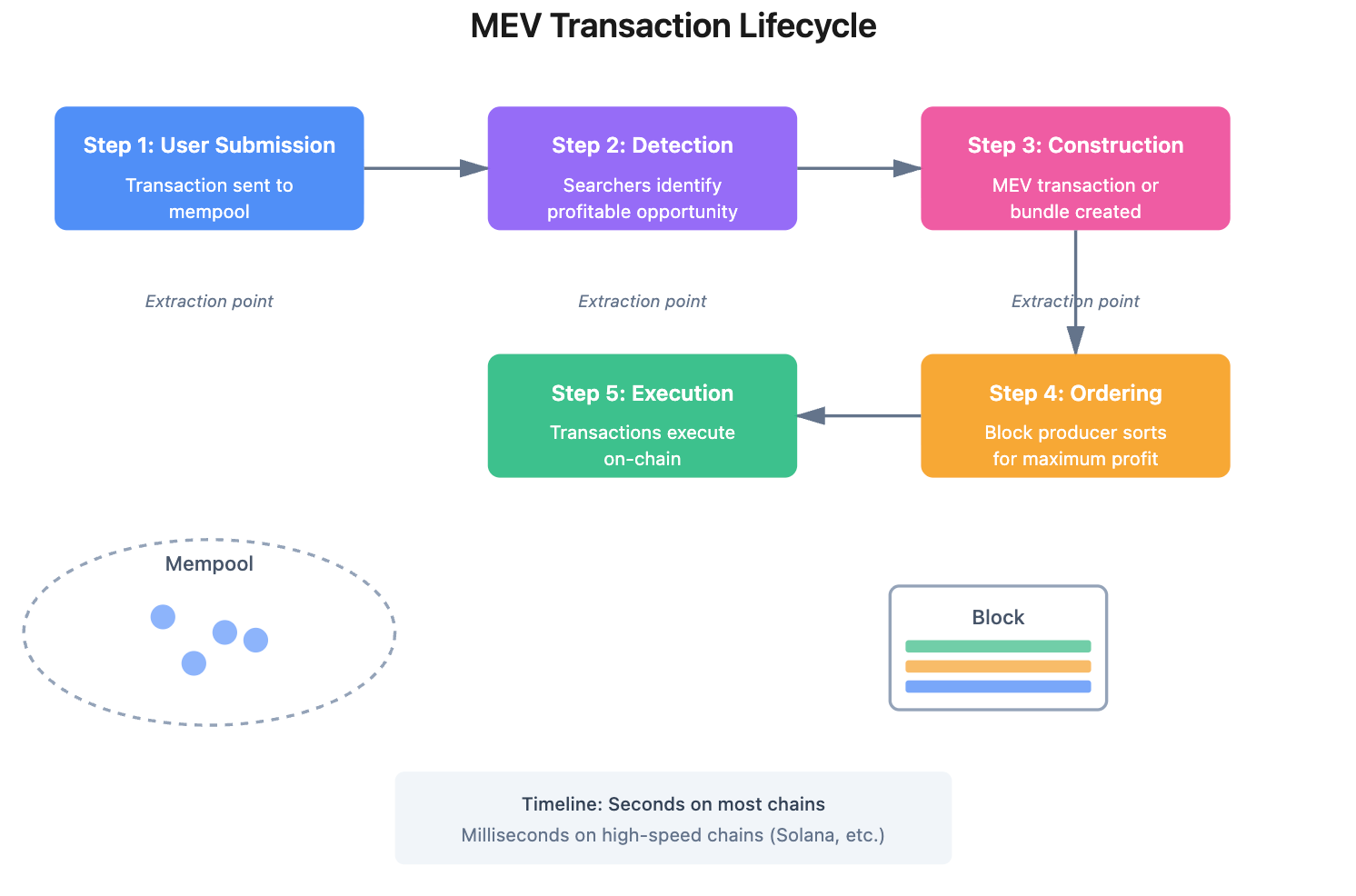
Each step creates extraction points. Searchers compete to detect opportunities first, then block producers decide which MEV transactions to include. On most high-throughput chains, this entire process happens within a few seconds, while on the fastest execution environments it can happen in milliseconds.
#Common MEV Strategies
MEV is not a single strategy but a collection of different ways to capture value from transaction ordering and state changes on-chain. Some strategies focus on market inefficiencies like price differences, while others depend on protocol rules such as liquidations or transaction priority around user activity.
The most common approaches include:
Arbitrage
Captures price differences for the same asset across decentralized exchanges.
Example: When a token trades at different prices on separate DEXs, searchers buy low on one platform and sell high on another to capture the spread. Profitability depends heavily on speed because bots usually close these gaps within seconds.
Liquidations
Profits from undercollateralized positions in lending protocols.
Example: When collateral falls below a protocol’s required threshold, liquidators can repay part of the debt and claim a reward. MEV bots monitor these positions continuously and submit transactions the moment liquidation becomes possible. Usually, the first liquidator wins.
Front Running
Profits from executing a transaction before another known transaction that is expected to move the market.
Example: If a large pending trade is likely to shift a DEX price, a searcher may try to place their own transaction first to benefit from that movement. Sandwich attacks are a specific subtype of front running, where the attacker places one transaction before and one after the user’s trade to capture profit from the resulting price impact. This is controversial because it directly worsens execution for regular users.
#Why Infrastructure Matters
At its core, MEV is essentially an infrastructure game. A profitable strategy on paper means very little if your transaction reaches the network too late, your node misses critical mempool activity, or your system fails during a high-value opportunity. In MEV, profits are often decided by milliseconds, so execution quality matters just as much as strategy design.
Failures usually happen in the gap between identifying an opportunity and successfully capturing it. A searcher might detect an arbitrage trade, but if their node receives mempool data too slowly, a competitor may act first. A liquidation bot may identify a profitable position, but network latency can delay submission long enough for someone else to claim it. Even temporary downtime during periods of heavy volatility can result in missing some of the most valuable opportunities entirely
This is why dedicated infrastructure matters. Running your own high-performance nodes provides faster and more reliable mempool access than public RPC providers, which often add latency, request limits, and inconsistent performance. Low-latency networking improves transaction delivery to validators, while reliable hardware and monitoring systems reduce downtime and execution failures.
As strategies expand across multiple chains, infrastructure becomes even more critical. Cross-chain MEV depends on timing across different networks, bridges, and settlement conditions, so operators need synchronized monitoring and fast execution across environments.
This is why serious MEV participants invest heavily in node infrastructure, monitoring systems, and execution pipelines, not just strategy development. Often, the real edge comes from being the first to execute successfully.
#Cross-Chain MEV Blockchain Opportunities and Complexities
Cross-chain MEV occurs when price or state differences exist across multiple blockchains, such as an asset that’s trading at different prices on Ethereum and Solana, which represents an arbitrage opportunity. These instances represent larger opportunities than those in single-chain MEV, but are notably harder to capture due to the need to coordinate operations across incompatible systems, each with distinctly different block times, consensus mechanisms, and transaction formats.
A profitable trade on one chain can quickly become a loss if the corresponding transaction on another chain is delayed, reordered, or fails entirely. Success depends on more than spotting the opportunity. Operators need fast detection systems to identify price gaps early, reliable infrastructure to monitor and execute across multiple networks, and strong risk management to handle bridge delays, settlement uncertainty, and capital exposure.
The next sections break this down further: where these opportunities appear, the infrastructure challenges involved, how operators monitor multiple chains at speed, and why execution and capital management often determine whether a strategy succeeds or fails.
#Types of Cross-Chain Opportunities
Cross-chain MEV appears wherever value can be captured from differences between blockchain networks. Unlike single-chain MEV, these opportunities depend on comparing prices, liquidity, or state across multiple systems and executing before those gaps close. The profit potential is often larger, but so is the operational complexity.
Cross-chain arbitrage
Exploits price differences for the same asset across chains.
Example: USD Coin trades across Ethereum, Solana, Avalanche, and BNB Smart Chain, and price discrepancies appear constantly. The idea is simple: buy where it is cheaper and sell where it is more expensive. In practice, bridge delays and price movement during transit make this much harder.
Bridge MEV
Captures value during asset transfers between chains.
Example: When users bridge assets, there is often a delay between funds being locked on one chain and minted or released on the destination chain. These timing gaps create opportunities around liquidity rebalancing, delayed minting windows, and transaction ordering.
Oracle arbitrage
Exploits differences in oracle configurations across chains.
Example: Services like Chainlink may update the same asset price at different speeds depending on heartbeat intervals or deviation thresholds. This creates short windows where the same asset is valued differently across chains, opening profitable trading opportunities.
Each of these strategies depends on speed, timing, and execution reliability. Finding the opportunity and capturing it requires systems that can monitor and coordinate operations across multiple chains, which leads directly to the operational challenges involved.
#Cross-Chain Infrastructure Challenges
Once opportunities are identified, execution becomes the real challenge. Cross-chain MEV is difficult because every blockchain has different timing, liquidity conditions, and execution rules. Success depends on managing these differences faster than competitors.
Block Time Mismatches
Different chains confirm transactions at very different speeds.
Example: Ethereum produces blocks roughly every 12 seconds, Solana around every 400ms, and Avalanche around every second. Faster chains allow quicker execution but increase competition, while slower chains provide more detection time but longer exposure to price movement.
Fragmented Liquidity
Liquidity is spread unevenly across chains and pools.
Example: Total USD Coin liquidity may be large globally, but individual pools on specific chains can be small. Large trades create slippage that can remove arbitrage profits, so operators need real-time liquidity tracking to size trades correctly.
Bridge Latency
Asset transfers between chains are often too slow for direct execution.
Example: Fast bridges may still take minutes, while slower ones can take hours. During that time, prices move and opportunities disappear. This is why operators often keep liquidity pre-positioned across multiple chains instead of bridging per trade.
Consensus Differences
Each chain handles MEV differently.
Example: Ethereum MEV is largely mempool-based, where operators watch pending transactions and compete for ordering. Solana has no public mempool, so MEV depends more on direct validator connections and priority fees. Each chain requires different monitoring and execution systems.
These challenges make it clear that strategy alone is not enough. Cross-chain MEV depends on having infrastructure capable of monitoring, coordinating, and executing across multiple environments at the same time.
#Monitoring Multiple Chains
Cross-chain MEV requires simultaneous monitoring of multiple blockchain states, and the need for high speed, reliable low-latency operation means that public RPC providers generally won’t be enough due to their rate limits, shared infrastructure, and added latency. With such providers you'd always be lagging behind operators running their own dedicated nodes.
Optimally, you need nodes running on every chain you intend to operate on, whether it’s Ethereum, Solana, Avalanche, BSC, or any other. In itself, this leads to hardware requirements that scale linearly with those chains. One Ethereum node needs 4TB+ storage. Add Solana (2TB), Avalanche (1TB), and BSC (4TB), and you're at a minimum of 11TBs just for blockchain data. But it doesn’t stop there, memory, CPU, and network demands scale just as quickly. Nodes must process blocks and mempool activity in real time while constantly syncing with peers and broadcasting transactions. Poor network performance adds latency, delays transaction visibility, and slows execution, which can mean losing profitable opportunities even when the strategy is correct.
State synchronization across chains is computationally expensive. You're watching multiple transaction sources across different networks. Processing this data, detecting opportunities, and executing trades requires substantial compute resources.
Many operators in the MEV blockchain space address this by running nodes on dedicated bare metal infrastructure. Dedicated server providers for blockchain, like Cherry Servers, offer configurations that would support multiple blockchain nodes simultaneously, giving operators the consistent performance needed for low-latency cross-chain monitoring.
#Execution Complexity
Detecting a cross-chain opportunity is one thing, but executing it profitably brings its own challenges. All transactions need to be submitted across multiple chains with coordinated timing, often within tight, shifting windows.
As an example, if you're arbitraging between Ethereum and Solana, the steps you would need to take are:
- Execute the buy on Ethereum,
- Wait for confirmation,
- Bridge assets to Solana (or use existing liquidity),
- Execute a sale on Solana,
- Bridge the profits back across.
The risk is that every step depends on timing. If the bridge is delayed, the price gap may close before the sale executes, turning a profitable trade into a loss. If the Solana transaction loses priority and is included too late, another searcher may capture the opportunity first while you are left holding the less profitable side of the trade.
This is why execution quality matters as much as opportunity detection. In cross-chain MEV, success often depends less on finding the trade and more on completing every step before market conditions change.
#Capital Requirements
By its nature, cross-chain MEV demands more capital than single-chain operations. Bridging capital between chains as funds are required is too slow and the opportunity will pass you by. You need liquidity on every chain you're operating across, so distributing funds across networks is key.
If you're running arbitrage across five chains, you might need $100k in working capital on each chain just to have the chance to execute meaningful trades. That's $500k locked up before even capturing a single opportunity.
In itself, this makes capital efficiency a critical optimization problem. Too much capital sitting idle reduces returns, while too little means missing opportunities because you can't execute large enough trades to overcome fees and slippage.
In practice, this often aligns with infrastructure decisions. If you are already running dedicated nodes on each chain for monitoring and execution, maintaining liquidity across those same networks becomes part of the same operational model. The infrastructure supports faster execution, while distributed capital ensures you can actually act when opportunities appear, making both strategy and execution far more consistent.
#The Role of Nodes in the MEV Blockchain Ecosystem
Nodes are the foundation of MEV infrastructure. Every opportunity detection, transaction simulation, and execution starts with blockchain data, so the quality and speed of that data determines which opportunities you see and how fast you can act on them.
While public RPC providers offer convenience, serious MEV operations are heavily hamstrung by the infrastructure . The rate limits restrict how many requests you can make, and that’s before considering that a shared infrastructure means slower response times. You're competing against operators with dedicated nodes who see opportunities first.
#Why MEV Operations Run Their Own Nodes
Running your own nodes is one of the most important differences between casual on-chain activity and serious MEV operations. Public RPC providers are useful for general blockchain access, but they are rarely fast or reliable enough for competitive MEV, where execution speed and full transaction visibility directly affect profitability.
The main advantages include:
Direct Mempool Access
Full visibility into pending transactions before they are confirmed.
Example: Public RPC providers often filter pending transactions or only expose confirmed state. MEV strategies like front running, arbitrage, and liquidations depend on seeing transactions the moment they enter the mempool. Operating your own node provides unfiltered access and faster detection.
Transaction Simulation
Fast local access to blockchain state for testing execution.
Example: Simulating MEV transactions requires reading current blockchain state thousands of times per second to verify profitability before submission. Public RPC rate limits make this impractical, while your own node allows unlimited state queries at local network speed.
Low Latency
Faster response times for detection and execution.
Example: Public RPC providers often introduce 50–200ms of round-trip latency through shared infrastructure, load balancers, and routing layers. A local node can respond in under 5ms, and that difference is often enough to decide who captures a profitable opportunity first.
Reliable Uptime
Fewer missed opportunities caused by provider outages.
Example: If an RPC provider experiences downtime, monitoring stops and profitable trades are missed. MEV operators treat node uptime like trading system uptime because even short outages can directly translate into lost revenue.
Owning the node means controlling the speed and reliability your strategies depend on. In competitive MEV environments, that control is often the difference between consistently capturing value and always arriving too late.
#Node Requirements Per Chain
Node requirements vary significantly by chain, and understanding the difference between storage, memory, and CPU demands is critical when planning multi-chain MEV infrastructure. While fast NVMe storage is essential across all chains, RAM and CPU requirements change depending on how each network processes transactions and state.
Storage Requirements
Fast NVMe storage is a baseline requirement for all serious node operations.
Example: Ethereum typically needs 2TB+ of storage, while Solana and BNB Smart Chain can require similar or higher capacity depending on retention and indexing needs. Slow disks create sync delays and poor state access, which directly affects MEV execution.
Memory Requirements
RAM requirements depend heavily on transaction throughput and state size.
Example: Ethereum commonly runs well with around 32GB RAM for standard operations, while Solana can demand hundreds of gigabytes, often 256GB to 512GB+, because of its high throughput and large active state requirements.
CPU Requirements
Processing power depends on how much real-time validation and state handling the chain requires.
Example: Avalanche benefits from strong multi-core performance because its three-chain architecture handles parallel activity across separate chains. Solana also places heavy CPU pressure during periods of high transaction volume, while Ethereum depends more heavily on stable state execution and mempool monitoring.
As more chains are added, these requirements scale almost linearly. Running multi-chain MEV operations means planning for the combined storage, RAM, and CPU load of every network.
#Running Multi-Chain Nodes
Operating nodes across multiple chains multiplies hardware requirements. It is strongly recommended that each chain has dedicated storage, memory, and CPU resources. While running Ethereum + Solana + Avalanche nodes on one server is technically possible, it is rarely optimal.
The problem is resource contention. If a Solana validator is processing high transaction throughput and heavy state updates, it can consume enough CPU and memory to slow down an Ethereum node trying to stay synced with the latest blocks and mempool activity. At the same time, Avalanche runs multiple internal chains, all generating constant disk reads and writes, which compete with Solana’s own intensive transaction processing. This results in slower syncing, delayed transaction visibility, and higher latency across every chain.
This is why most serious operators run separate servers per chain, or at least isolate high-resource chains like Solana and Ethereum while grouping lighter chains such as Avalanche and BNB Smart Chain together.
When you are running multiple high-performance blockchain nodes, eliminating resource contention and virtualization overhead is critical for maintaining the low-latency data access MEV operations require. This is where dedicated bare metal infrastructure offers clear advantages over cloud instances, giving operators predictable performance and consistent execution speed.
Why Node Performance Matters
MEV is a competition measured in milliseconds. The operator whose node sees a pending transaction 10ms before yours gets to frontrun first, and the operator whose state queries return 5ms faster simulates and submits those transactions sooner. Node performance directly correlates with MEV capture rates. Faster nodes mean more opportunities detected and faster execution. This is why professional operations rarely cut costs on hardware, opting to invest in high-performance infrastructure rather than cloud instances or public RPC providers.
The MEV blockchain ecosystem rewards infrastructure excellence as much as strategy sophistication. You can have the best arbitrage algorithm in the world, but if your nodes are slow, you'll lose to worse algorithms running on better infrastructure.
#Building Robust Infrastructure for MEV Blockchain Systems
MEV infrastructure is a layered system. Data flows from blockchain nodes through processing pipelines to strategy engines and execution systems. Each layer needs to be fast, reliable, and properly architected.
#Infrastructure Layers
A complete cross-chain MEV stack typically includes four layers working in coordination, each responsible for a different part of identifying and capturing opportunities across chains.
Data Layer
Handles blockchain information gathering.
Example: This includes running full nodes, archive nodes when needed, mempool listeners, and indexing services. Its role is to collect raw blockchain data and make it available to the rest of the system.
Strategy Layer
Processes data to detect profitable opportunities.
Example: Arbitrage detection engines, liquidation monitors, and opportunity analyzers operate here. This layer takes raw blockchain activity and determines where profitable actions exist.
Execution Layer
Submits transactions to capture identified opportunities.
Example: Transaction builders create bundles, priority fee optimizers determine gas pricing, and submission systems send transactions to nodes, validators, or relay networks.
Cross-Chain Layer
Coordinates activity across multiple blockchains.
Example: Bridge monitors track asset movement between chains, oracle monitors watch price feed updates, and multi-chain state trackers maintain synchronized views of conditions across networks.
Each layer has different performance requirements, but they must work together seamlessly. Delays or failures in one layer can prevent the entire strategy from succeeding.
#Data Layer Architecture
The data layer forms the foundation of a cross-chain MEV system. Its job is to collect blockchain information quickly and reliably so the rest of the stack can detect and act on opportunities before competitors do.
Node Infrastructure
Full nodes provide the raw blockchain data needed for monitoring and execution.
Example: For multi-chain MEV, you need nodes on every chain you operate across. These nodes cannot share resources effectively, as each requires dedicated CPU, memory, storage, and network capacity to stay synced and provide low-latency access.
Storage Requirements
Blockchain data alone creates significant storage demands.
Example: Running nodes for Ethereum (2TB), Solana (2TB), Avalanche (1TB), and BNB Smart Chain (2TB) already requires around 7TB just for chain data, excluding indexing databases, transaction logs, and application storage.
Indexing Systems
Raw blockchain data must be transformed into something usable.
Example: Nodes expose blocks, transactions, and state changes, but strategy engines need fast, structured access. Indexers parse this information into queryable databases that support arbitrage detection, liquidation monitoring, and other automated strategies.
Mempool Listeners
Real-time transaction monitoring is critical for MEV.
Example: Mempool listeners maintain persistent WebSocket connections to nodes and track pending transactions before they are included in blocks. During high-activity periods, mempools can produce thousands of transactions per second, so these systems must process large volumes of data with minimal delay.
#Strategy Layer Components
The strategy layer turns raw blockchain data into actionable opportunities. Its role is to detect profitable conditions, test whether execution will work, and control risk before capital is committed.
Opportunity Detection Engines
Continuously scan blockchain activity for profitable trades.
Example: For arbitrage, this means monitoring DEX pool states and calculating price differences across exchanges. For liquidations, it means tracking collateral ratios in lending protocols and identifying positions close to liquidation thresholds.
Computational Requirements
Opportunity detection demands significant processing power.
Example: Checking thousands of arbitrage paths across multiple DEXs requires heavy CPU usage, while monitoring lending positions across protocols depends on fast database queries and real-time state updates.
Simulation Systems
Test transactions before submitting them on-chain.
Example: A potential MEV transaction is constructed and simulated against the current blockchain state to confirm profitability. This helps catch failed trades before they waste gas fees or expose capital to unnecessary risk.
State Access for Simulation
Accurate simulation depends on fast and complete blockchain state access.
Example: Some operators run local blockchain forks for testing, while others rely on specialized simulation services. In both cases, low-latency access to up-to-date chain state is essential.
Risk Management Systems
Prevent losses when strategies fail or market conditions change.
Example: These systems track capital allocation across chains, monitor position sizes, and enforce limits on trade sizes and gas spending. If a strategy begins losing money, risk controls can pause or shut it down before losses compound.
#Execution Layer Infrastructure
The execution layer is responsible for turning detected opportunities into successful on-chain transactions. Speed, timing, and reliability matter most here because even profitable strategies fail if execution is too slow or poorly prioritized.
Transaction Builders
Construct transactions or bundles in the correct format for execution.
Example: On simpler chains, this may be a single transaction with the right parameters. For more complex MEV strategies, it can involve multiple transactions bundled together with strict ordering requirements.
Priority Fee Optimization
Determines how much to pay for transaction inclusion.
Example: If fees are too low, the transaction may not execute in time. If they are too high, profits are lost to unnecessary costs. These systems monitor congestion and recent inclusion patterns to balance speed with profitability.
Private Relays
Submit transactions directly to validators or block builders instead of public mempools.
Example: This reduces the risk of frontrunning, but it also requires integration with private relay networks and understanding how each chain handles transaction inclusion.
Chain-Specific Execution Systems
Different blockchains require different execution paths.
Example: Flashbots on Ethereum routes bundles to block builders who construct full blocks, while Jito on Solana sends bundles directly to validators for atomic execution. Multi-chain operators must support both models.
Fallback Systems
Provide backup execution paths when the primary route fails.
Example: If a private relay submission fails, the system may fall back to another relay or the public mempool. This improves reliability and reduces the chance of missing opportunities due to a single point of failure.
#Cross-Chain Coordination
Cross-chain coordination connects the rest of the MEV stack across multiple networks. Its role is to track what is happening between chains and ensure opportunities are identified and acted on before timing differences remove profitability.
Bridge Monitors
Track asset movement between blockchains.
Example: When users bridge tokens, there is often a delay before assets appear on the destination chain. Monitoring these in-progress transfers helps predict liquidity shifts and identify temporary pricing imbalances.
Oracle Monitors
Watch price feed updates across networks.
Example: Services like Chainlink and Band Protocol update prices on different chains at different times. Knowing which chains have stale oracle prices creates short-lived arbitrage opportunities.
State Synchronization
Maintains an up-to-date view of conditions across every chain.
Example: This requires running nodes, indexing data, and keeping databases synchronized so that when state changes on one chain, the system can immediately recalculate cross-chain opportunities.
Auction Awareness for Solana
Tracks validator competition in bundle-based execution systems.
Example: For Solana MEV operations, monitoring Jito bundle auction activity helps estimate current tip rates and competition levels. Higher tip periods usually signal stronger MEV opportunities, while lower tips suggest less competitive conditions.
#Networking Considerations
Networking is one of the most important parts of MEV infrastructure because even strong strategies fail if data arrives too late or transactions are submitted too slowly. Low-latency communication between systems directly affects whether an opportunity is captured or lost.
Low-Latency Internal Networking
Keep communication between infrastructure components as fast as possible.
Example: If a strategy server queries a database and waits even 10ms for a response, a faster competitor may already have executed the trade. Database servers, strategy engines, and execution systems should be placed close together to reduce delay.
Local Network Design
Minimize unnecessary network hops.
Example: Nodes, databases, and execution systems should ideally run on the same local network or at least within the same data center. Cross-region communication adds latency that can make profitable MEV strategies uncompetitive.
High-Bandwidth Internet Connectivity
Support constant blockchain syncing and transaction submission.
Example: MEV systems continuously pull blockchain data from nodes while also sending transactions across multiple networks. A 1Gbps connection may work at smaller scale, but during high-activity periods across several chains, operators often need 10Gbps capacity for consistent performance.
Redundant Connections
Prevent outages during valuable market windows.
Example: If a primary internet connection fails during a high-value opportunity, redundant network paths keep operations running and reduce the risk of missing profitable execution windows.
#Scaling Considerations
As you add more chains or strategies, infrastructure needs to scale with them. Expanding from an Ethereum and Solana setup to include Polygon, for example, means provisioning another node server, increasing database capacity, and deploying additional strategy and monitoring systems.
Horizontal Scaling
Add more servers as operations grow.
Example: This is usually more effective than vertical scaling, which relies on increasingly larger individual servers. Horizontal scaling lets operators add capacity incrementally, isolate workloads by chain, and reduce the risk of one overloaded machine affecting the entire system.
Infrastructure as Code
Manage infrastructure programmatically instead of manually.
Example: Tools like Ansible, Terraform, and [Kubernetes]https://www.cherryservers.com/blog/install-kubernetes-ubuntu) make it easier to deploy, configure, and maintain nodes, databases, and execution systems consistently across multiple environments.
As operations grow, manual management becomes a bottleneck. Scalable MEV infrastructure depends not on only adding more hardware, building systems that can expand reliably without introducing new points of failure is also crucial.
#Cost Management
MEV infrastructure is expensive. Server costs, bandwidth, monitoring tools, and budgets for personnel to maintain everything add up quickly. Budgeting requires understanding both the fixed cost elements, such as servers and tools, and the variable costs like transaction fees, and failed trade losses.
Most operations find a threshold stake where infrastructure costs make sense. If you're only capturing $5,000 monthly in MEV, but spending $10,000 on infrastructure, that’s a clear money drain. But at $50,000+ monthly MEV capture, investment in quality infrastructure can end up paying for itself.
#Future Trends and Best Practices in the MEV Blockchain Ecosystem
The MEV blockchain landscape evolves rapidly. New protocols, execution models, and market structures constantly change how value is created and captured. Strategies that work today may become less effective as new infrastructure emerges and competition increases.
To stay competitive, operators need to look beyond current opportunities and understand where MEV is heading next. Shared sequencing, cross-chain builders, and MEV auction systems are already changing how transaction ordering works across networks, while infrastructure design and operational discipline determine who can actually take advantage of those changes.
The following sections explore these emerging models, how they affect cross-chain execution on networks like Ethereum and Solana, and the practical best practices that help operators build reliable long-term MEV systems.
#Shared Sequencing
Shared sequencers coordinate transaction ordering across multiple chains simultaneously. Instead of each chain having its own independent sequencer, a shared sequencer orders transactions for multiple networks.
This creates cross-chain MEV opportunities that don't exist with isolated sequencers. If one entity orders transactions for both Arbitrum and Optimism, they can coordinate state changes across both chains automatically, making bridge arbitrage instant rather than requiring time for asset transfers.
Shared sequencing is still an emerging model, but projects like Espresso Systems and Radius are building production systems designed to provide transaction ordering across multiple rollups and chains through a single coordination layer.
For node operators, this changes how opportunities are monitored and executed. Instead of treating each chain as a separate environment, systems need to track multiple networks as part of one shared execution flow. Opportunity detection, transaction submission, and risk management all become more connected, which can reduce bridge delays but also increases the need for synchronized monitoring and faster decision-making across chains.
#Cross-Chain Builders
Typically, block builders operate on a per-chain basis, meaning they observe transactions, construct bundles, and optimize block value for a single network only. Ethereum has its own builder ecosystem, where builders compete to create the most profitable blocks for validators, while other chains follow their own separate execution models and auction systems.
Cross-chain builders work differently. Instead of optimizing for one chain at a time, they coordinate block construction across multiple networks to capture value that only exists when those chains are viewed together.
A cross-chain builder might see that:
- A user bridges ETH from Ethereum to Arbitrum;
- This creates temporary price pressure on Arbitrum;
- The builder includes arbitrage trades on Arbitrum in the same block that the bridged ETH arrives;
- The value extracted spans both Ethereum (via bridge transaction) and Arbitrum (arbitrage).
Supporting this requires coordinated monitoring across multiple chains, synchronized transaction submission, and bundle construction that can handle incompatible execution environments.
#MEV Auctions and Fair Distribution
As MEV has grown, different systems have emerged to decide who captures that value and how it is shared. Instead of all profits going directly to searchers or validators, some networks now use auction models that let participants compete for transaction inclusion while redistributing part of the value back to validators, stakers, or even users.
The two most established examples are Flashbots on Ethereum and Jito on Solana. Both are designed to improve how MEV is handled, but they take very different approaches, which matters for anyone running MEV strategies on one chain or across both.
Flashbots introduced the MEV auction model on Ethereum through MEV-Boost. Builders construct entire blocks and bid for the right to propose them to validators. Searchers submit transaction bundles to builders, who combine them into optimized blocks. The winning builder then pays the validator, often sharing 90–95% of the MEV value.
User rebates happen through opt-in services like Flashbots Protect and MEV-Share, where users choose to share transaction data in exchange for part of the extracted value. This full-block approach improves transparency, but it also means searchers and operators must work through builders and relays rather than directly through standard transaction flow.
Jito on Solana uses a different model based on bundle auctions rather than full-block building. Searchers create bundles of up to five transactions that execute atomically, then submit them to Jito’s block engine with tip-based bids. Validators running Jito-Solana can include these bundles alongside regular transactions, and those tips are distributed to validators and stakers.
For operators, the difference is practical. Running MEV on Ethereum means understanding builders, relays, and MEV-Boost auctions. Running on Solana means working with Jito bundles, priority fees, and direct validator relationships. Running across both requires supporting both systems at once, since execution, bidding, and transaction guarantees work differently on each chain.
Auction systems change MEV economics. Searchers no longer keep all extracted value and must compete by sharing part of it for inclusion priority. This lowers profit per trade, but it also creates more sustainable ecosystems where users, validators, and stakers all benefit from MEV participation.
#Best Practices for MEV Infrastructure
Best practices for MEV infrastructure depend on where and how you operate. Running MEV on a single chain like Ethereum has different requirements from operating across both Ethereum and Solana, but the goal is always the same: reduce latency, improve execution reliability, and avoid unnecessary capital loss.
For Ethereum-focused MEV
Prioritize reliable mempool access, private relay integration, and builder awareness.
Example: Running your own high-performance Ethereum node provides faster access to pending transactions than public RPC providers. Integration with Flashbots and MEV-Boost relays is essential for bundle submission, while simulation systems help verify profitability before spending gas.
For Solana-focused MEV
Focus on validator connectivity, fast state updates, and bundle auction awareness.
Example: Since Solana does not rely on a public mempool in the same way, operators need strong connections to validators and systems that monitor Jito bundle auctions and tip rates. Priority fee optimization and low-latency execution matter heavily here.
For Cross-Chain MEV
Build around synchronized monitoring and distributed capital.
Example: Dedicated nodes on every chain are critical, as relying on shared infrastructure creates latency and missed opportunities. Capital should already be positioned across networks because bridging funds during execution is usually too slow. Bridge monitoring, oracle tracking, and fast state synchronization help prevent exposure from delayed settlement.
For All Setups
Redundancy and failure recovery should never be optional.
Example: Backup transaction routes, automated failover systems, and continuous monitoring reduce the risk of missed opportunities during volatility. In MEV, a small delay or single point of failure can be the difference between profit and loss.
The strongest operators are usually not the ones with systems reliable enough to execute consistently when opportunities appear.