What is a Dedicated Game Server and How Does it Work?



A dedicated game server is a standalone machine used exclusively to host multiplayer video games, managing all game logic, data, and connections independently of any individual player's device.
As opposed to peer-to-peer hosting, in which the personal computer of one of the players becomes a server, the dedicated servers ensure a stable and centralized working platform that improves the game speed and avoids issues with the other participant's computer.
Gaming communities, competitive gamers, and participants who want greater server assurance, lower latency, and a vast array of configurations typically use dedicated servers.
Multiplayer gaming sits inside a large and growing market. Newzoo valued the global games market at $189 billion in 2025, with a player base of about 3.6 billion, of whom 936 million were on PC. Reliable hosting underpins that scale, and dedicated servers are how studios and communities keep fast-paced games stable for everyone connected.
#How does a dedicated game server work?
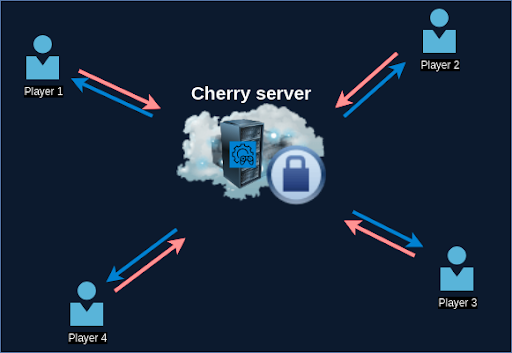
Dedicated game servers operate through a centralized architecture where the server machine, typically housed in a data center, manages all game data, world states, player statistics, and interactions.
This setup contrasts sharply with peer-to-peer hosting, where a player's device doubles as a server, distributing connection loads across peers but often causing performance issues when the "host" leaves or experiences network problems.
Dedicated servers maintain an always-on environment where the server machine exclusively handles all players' requests, making game states and interactions stable and consistent.
A typical dedicated server setup requires high-performance hardware capable of handling multiple simultaneous player connections, rapid data processing, and real-time event management. Key components include a fast CPU, substantial RAM, reliable storage (often SSDs), and a high-bandwidth internet connection.
Efficient networking configurations are essential for quickly connecting players to the server, ensuring minimal latency. Network ports, protocols like TCP or UDP (for rapid packet delivery), and firewall configurations also play crucial roles in maintaining connection quality and server security.
Dedicated game servers may utilize load balancers to distribute traffic efficiently, ensuring peak performance even under heavy usage.
#Benefits of dedicated game servers
Here are some of the benefits to expect when opting to use a dedicated game server:
-
One of the primary benefits of dedicated game servers is their enhanced gameplay performance and stability, which is especially critical for games demanding high responsiveness. Unlike other setups, dedicated servers minimize lag by managing data on a powerful, always-connected machine, resulting in more stable frame rates and lower latency.
-
Players enjoy a smooth experience regardless of individual connection quality, as the server handles all interactions without relying on any player's device.
-
Specific gaming servers also give administrators greater control for customizing the gaming experience.
-
Server owners can change particular game characteristics, like introducing various mods and restrictions or building a particular atmosphere and rules for selected communities.
-
Most dedicated servers come with advanced DDoS protection, firewalls, and security protocols to shield them from hackers or toxic participants.
-
Finally, dedicated servers make it possible to build communities as players are served through the consistency with which they interact to create end-user items like player-created guilds, teams, factions, in-game assets, etc., thereby fostering long-term end-user community building. The server's continuous availability encourages a committed player base, enhancing the social dynamics and loyalty within the gaming community.
Related reading: 8 Best Dedicated Game Server Providers in 2025
#Popular games using dedicated servers
Several popular games utilize dedicated servers to offer reliable, lag-free multiplayer experiences:
-
Minecraft: With its open-world sandbox environment and high customizability, Minecraft benefits significantly from dedicated servers. Server owners can create custom worlds, install plugins, and manage player communities, allowing for personalized, persistent game worlds where players can build, explore, and collaborate.
-
Counter-Strike 2: The fast-paced action of Counter-Strike 2, which replaced CS:GO in 2023, demands precision and low latency, which is why dedicated servers are the default for official and competitive matches. These servers maintain consistent, real-time game states, ensuring fair play and the high performance that competitive scenes require.
-
ARK: Survival Evolved: Known for its resource-intensive, open-world gameplay, ARK benefits from dedicated servers that handle its complex ecosystem, player interactions, and persistent world state. Server administrators can adjust the difficulty, enable mods, and provide unique community-based survival experiences.
-
Valheim: As a multiplayer survival game, Valheim relies on dedicated servers to support its procedurally generated worlds and cooperative gameplay. Dedicated servers allow players to maintain a persistent world where they can revisit, build, and progress even when other players are offline.
-
Rust: Persistent dedicated servers keep Rust online around the clock, tracking player-built bases and world state between sessions. Server owners configure wipe schedules, player limits, and mods, so dedicated hardware is essential for a stable, long-running community.
#Technical requirements
To run a dedicated gaming server efficiently, specific hardware and network configurations are essential to ensuring low latency, high performance, and stability for connected players. Meeting these technical requirements means tailoring hardware, bandwidth, storage, and memory for optimal handling of game processes, data storage, and user connections.
#Hardware specifications
Dedicated game servers rely on robust hardware to handle real-time player actions and maintain game stability.
-
High clock speed matters most for game servers, because each match or instance leans on single-thread performance. A current high-frequency CPU, such as the AMD Ryzen 7700X (8 cores, 16 threads, 4.5 GHz), handles competitive and open-world servers well.
-
For higher player counts and multiple instances on a single machine, AMD EPYC 9004-series processors, such as the 24-core 9254 or 32-core 9354, provide the cores and memory bandwidth to manage hundreds of concurrent players.
-
A capable game-server configuration on a current dedicated server starts at roughly $50 to $180 per month, while high-core-count builds for large player bases run higher.
-
SSDs are now a standard for game server storage due to their low latency and high speed, which are crucial for games with frequent data access, such as Minecraft or ARK: Survival Evolved.
-
A 500 GB SSD may be adequate for small to medium communities, but for heavily modded games or persistent worlds, a 1 TB SSD is recommended.
-
Current dedicated servers typically include NVMe SSDs by default, so you get fast storage without an additional charge.
#Bandwidth requirements
High bandwidth ensures smooth data flow between players and the server, which is essential for minimizing latency.
-
A competitive shooter with 20–50 players per server, such as Counter-Strike, requires a minimum of 500 Mbps bandwidth to handle player data in real-time.
-
Games with higher player counts or frequent world updates (like Rust or ARK) benefit from 1 Gbps bandwidth.
-
Hosting providers typically include 1 Gbps connections in their mid-to-high-tier plans, with additional bandwidth upgrades available.
#Operating system considerations
Choosing the appropriate operating system impacts server performance and software compatibility.
-
Linux distributions like Ubuntu Server or CentOS are often preferred due to their efficient resource usage and compatibility with most game server software, minimizing OS-level overhead and maximizing hardware utilization.
-
Linux servers offer streamlined setup and lower operating costs, as they are open-source and do not require licensing fees.
-
Windows Server, while sometimes necessary for specific game server applications, adds an average of $20–$30 monthly in licensing fees, which can increase overall costs if multiple servers are required.
#Storage needs
Storage requirements vary widely by game.
-
A basic Minecraft server with minimal mods can operate with as little as 50 GB, while a heavily modded version of ARK may require upwards of 200 GB.
-
SSDs are the optimal choice for storage due to their high speed and low latency, which is critical for quickly loading world data and assets.
-
While an entry-level 256 GB SSD can suffice for smaller games, larger open-world or sandbox games benefit from 512 GB to 1 TB SSDs to accommodate player data, custom worlds, and regular backups.
#RAM and CPU requirements
The amount of RAM impacts how many players the server can support and the complexity of game environments.
-
A small game server with limited users may perform well with 8 GB of RAM, while more demanding environments, such as those supporting mods and larger player bases, require at least 16 GB.
-
Games with complex simulations, like ARK or Conan Exiles, often necessitate 32 GB of RAM, especially if the server hosts multiple worlds or high levels of AI processing.
-
CPU requirements vary significantly by game type, with intensive multiplayer games needing multi-threaded performance for smooth gameplay. For example, high-paced shooters or RPGs with complex AI may benefit from a processor with high single-core speeds (3.5 GHz or above) for rapid data processing.
#Game server hardware requirements by game
Hardware needs vary widely by title and player count. The table below gives a starting point for popular dedicated-server games. Treat these as baselines for a small-to-medium community, since large or heavily modded servers need more.
| Game | Players | CPU | RAM | Storage | Bandwidth |
|---|---|---|---|---|---|
| Minecraft (Java) | 10–20 | High clock, 2–4 cores | 4–8 GB | 50 GB SSD | 100 Mbps |
| Counter-Strike 2 | 10–32 | High clock, 2–4 cores | 4–8 GB | 50 GB SSD | 500 Mbps |
| Valheim | 10 | High clock, 4 cores | 8–16 GB | 50 GB SSD | 100 Mbps |
| ARK: Survival Ascended | 20–70 | 6–8 cores | 16–32 GB | 100+ GB SSD | 1 Gbps |
| Rust | 100–200 | 8+ cores | 16–32 GB | 60+ GB SSD | 1 Gbps |
These figures assume one game instance per machine. Hosting several instances, adding mods, or running larger maps raises the CPU, memory, and storage you need.
#Dedicated game server vs VPS and cloud hosting
Game servers can run on a VPS, a cloud instance, or dedicated bare metal, and the right choice depends on player count, budget, and how much performance consistency you need.
A virtual private server (VPS) partitions a single physical machine into multiple virtual machines. It is affordable and quick to set up, making it suitable for small servers hosting a handful of friends or a light Minecraft world. The drawback is shared hardware: a busy neighbor on the same host can cause lag spikes during peak play, which competitive games punish.
Cloud instances add easy scaling and pay-as-you-go billing, useful for events or seasonal player spikes. They still run on shared, virtualized hardware, so per-core performance is less predictable than dedicated hardware, and costs climb quickly for always-on servers.
A dedicated game server gives you the entire physical machine. No other tenants compete for CPU, memory, or network resources, so frame times and latency remain consistent under load.
Dedicated hardware also gives full control over the operating system, mods, and security, which matters for persistent worlds and large competitive communities. The trade-off is that you manage the server yourself, and an idle machine still incurs the same cost.
For most serious or growing communities, bare metal offers the best price-to-performance once a server runs consistently busy.
#How to choose a dedicated gaming server provider?
Selecting a dedicated server provider for gaming requires balancing cost, location, support, and security to ensure an optimal and reliable experience. Providers offer different configurations and services, and understanding these can help make a choice aligned with the server's needs.
#1. Pricing and cost
Providers price servers in different ways, commonly pay-as-you-go hourly rates or fixed monthly plans. Hourly billing suits short-lived or event servers, while longer-term billing lowers the cost of an always-on community. Beyond the base server, watch for setup fees, managed-service charges, backups, and bandwidth overages, since these decide the true monthly cost.
Matching the plan to your actual player count prevents you from paying for resources you never use. Cherry Servers offers hourly and monthly billing on its dedicated game servers, so you can start small and scale as your community grows.
#2. Geographic server locations
Server location significantly impacts latency, making geographic proximity to the target player base crucial. Selecting a provider with data centers near your primary user base reduces data travel time and enhances in-game response times, which is critical for a smooth gaming experience.
A provider with multiple locations also allows scaling for regional demand by deploying servers closer to emerging player communities.
#3. Technical support availability
Technical support can be critical for resolving server issues quickly, especially during high-player activity. Providers offering 24/7 technical support ensure that hardware or network problems impacting gameplay can be promptly addressed. This is particularly important for gaming communities that require minimal downtime and immediate resolutions to maintain player engagement.
#4. DDoS protection features
DDoS protection is vital for gaming servers due to their susceptibility to attacks that can disrupt player connections and compromise server performance. Providers with built-in DDoS mitigation prevent service interruptions and safeguard user experience. This is particularly relevant for competitive games, where consistent server availability and reliability are expected.
#Common challenges of running a dedicated game server
Running your own game server gives you control, but it also brings a few ongoing responsibilities worth planning for.
DDoS attacks are the most visible threat. Gaming is one of the most attacked sectors online; Cloudflare reports that many of these strikes come from competitors trying to knock a rival server offline. Choose a provider with built-in DDoS protection, and keep your server software patched.
Maintenance is the next commitment. Operating system updates, game-server patches, and mod compatibility all need attention, and a missed update can break a server or open a security hole. Scheduling regular maintenance windows keeps disruption predictable.
Scaling for player spikes is harder on a single machine. A launch weekend or a popular event can push player counts beyond what a single server can handle, leading to lag or crashes. Plan headroom into your hardware, or be ready to add servers and split players across them.
Cost control rounds out the list. A dedicated machine costs the same whether it is full or idle, so size it to your real player base and review usage before paying for a larger tier.
#Conclusion
A dedicated game server gives multiplayer games the stable, low-latency foundation that shared hosting struggles to match. The right setup comes down to matching hardware to your game and player count, protecting the server against DDoS attacks, and choosing a provider whose locations and billing fit how you play.
When you are ready to host your own, start by sizing a server to your game using the table above, then pick a location close to your players. Cherry Servers' dedicated game servers pair high-clock hardware with built-in DDoS protection, and you can deploy in minutes to test a configuration before you commit.
FAQs
What is a dedicated game server?
A dedicated game server is a single physical machine used only to host a multiplayer game. It manages all game logic and player connections, which keeps gameplay stable and consistent for everyone connected.
Do I need a dedicated server to host a game?
Not always. Small sessions can run peer-to-peer or on a VPS, but a dedicated server is the better choice for persistent worlds, competitive play, or larger player counts that need consistent performance.
How much does a dedicated game server cost?
A capable dedicated server starts at roughly $50 to $180 per month, depending on the CPU, memory, and storage. High-core configurations for large communities cost more, and hourly billing can lower the cost of short-lived servers.
What hardware do I need for a game server?
Most games rely on a high-speed CPU, enough RAM for the player count, fast NVMe storage, and low-latency bandwidth. A small server may run on 4 to 8 GB of RAM, while large or modded worlds need 16 to 32 GB.
Is a dedicated server better than shared game hosting?
For performance, yes. A dedicated server has no other tenants competing for resources, so latency and frame times stay steady under load, which matters most for fast-paced and competitive games.
For game servers, is clock speed or core count more important?
Clock speed usually matters more because each match leans on single-thread performance. Core count becomes important when you host many players or run multiple game instances on a single machine.